

SAROS Review
Table of Contents
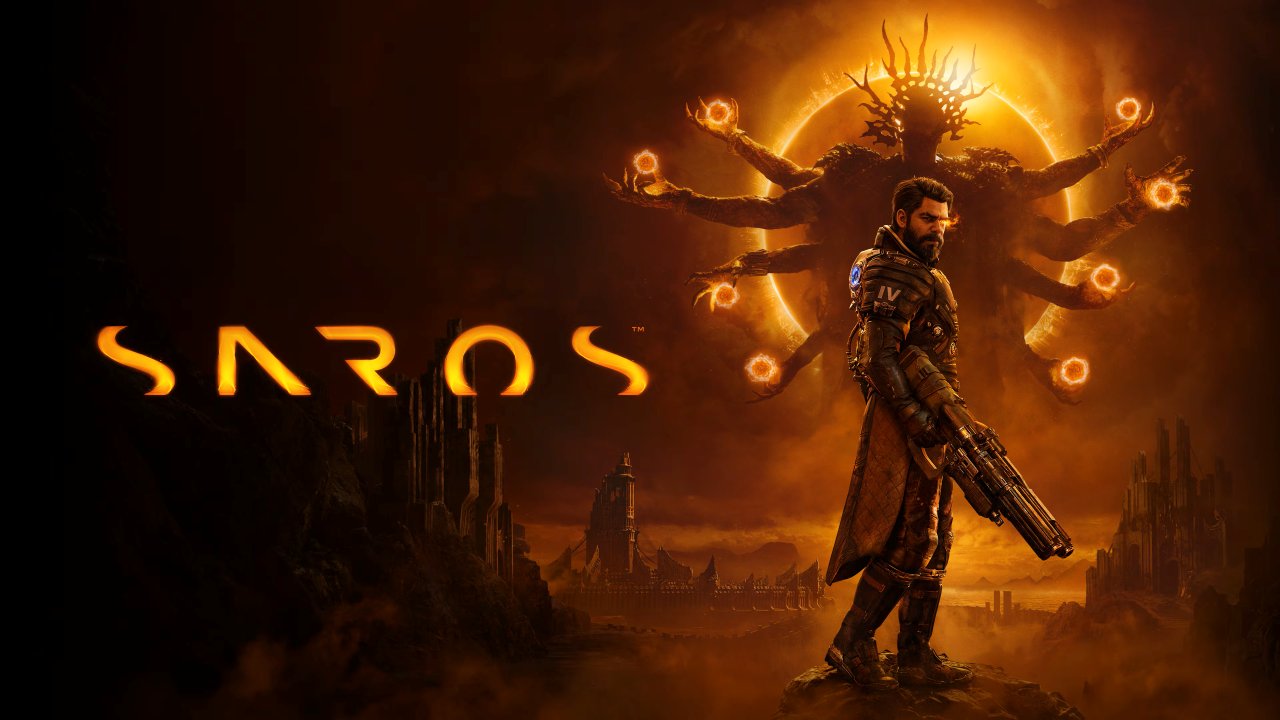
Housemarque’s SAROS is the highly anticipated follow‑up to the award‑winning Returnal, once again blending roguelite progression with the studio’s signature “bullet ballet” combat. Players step into the role of Arjun Devraj, an elite enforcer for the off‑world corporation Soltari, dispatched to investigate colony ships that have mysteriously gone silent while surveying the resource‑rich planet Carcosa, home to coveted deposits of Lucenite.
For Arjun, the mission carries a personal weight because his estranged wife, Nitya, was aboard a previous expedition. But after witnessing Carcosa’s awe‑inspiring solar eclipse, Arjun and the crew of Echelon IV are stranded, besieged by the planet’s hostile environment and the creeping madness that begins to unravel his comrades.
Caught in an endless cycle of death and rebirth, Arjun must navigate Carcosa’s unforgiving landscapes while clinging to the hope of finding Nitya. Each run pushes him deeper into the planet’s mysteries, testing his resolve against both external threats and the psychological toll of survival.
Come Back Stronger
The key distinction between SAROS and Returnal lies in accessibility, and boy, have Housemarque made the curve extra buttery smooth. While Returnal was a notoriously punishing roguelike that reset nearly all progress after each death, preserving only data logs and select resources, SAROS introduces a more player‑friendly progression system that welcomes newcomers but also invites back bullet-ballet veterans for another go.
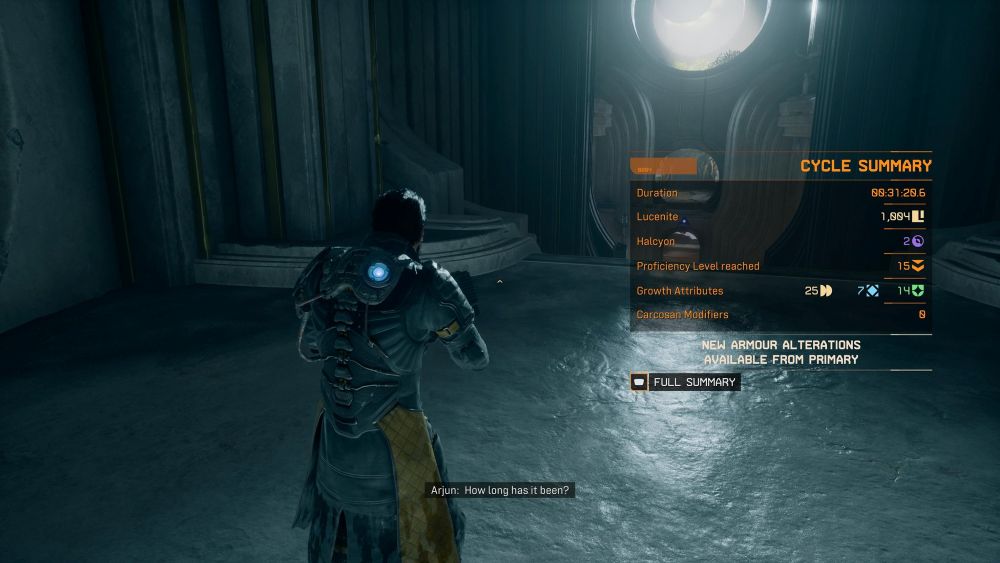
In Carcosa, players collect resources such as Lucenite and Halcyon during each run. Upon death, these resources (minus a death penalty) carry over, allowing players to purchase permanent upgrades to armor and core stats: Resilience (defense), Command (power), and Drive (Lucenite gain). Additional enhancements include weapon proficiency, healing effectiveness, and other suit protocols that gradually strengthen with each attempt. While skill is still the number one factor to consider, these incremental boosts that you get every run help alleviate the pressure.
Accessibility is further expanded through the Carcosa Modifiers, which are customizable toggles that let players tailor the difficulty to their preferences. Need faster reloads? There’s a modifier for that. Struggling with survivability? Toggle increased armor. For those craving Returnal’s crushing challenge, modifiers can also amplify enemy damage or reduce player resilience, ensuring hardcore fans aren’t left behind.
This is a great way to approach the game, especially for those who feel stuck at a wall they cannot overcome. These are purely optional, but they’re there for players who want to make their journey across Carcosa a bit more manageable or tougher.
Housemarque also addresses one of Returnal’s biggest criticisms: having to restart from the very beginning every run. In SAROS, progression eventually unlocks the World Dial, a fast‑travel system that teleports players directly to cleared biomes. This eliminates the need to retrace complex pathways and allows you to return to base after completing a biome or ending a run. This is a godsend, and Housemarque has made it in such a way that the time you spend in the game is focused on making progress on the biomes, and not wasted on running from one end to another.
Despite these improvements, SAROS retains the tension that made Returnal fantastic. Progress can still be lost if the game resets unexpectedly, and missions typically last 20–30 minutes, keeping runs intense but not overly drawn-out. By balancing punishing mechanics with thoughtful accessibility features, SAROS ensures players can experience its depth without being discouraged before the adventure truly unfolds.
The Shore Beckons
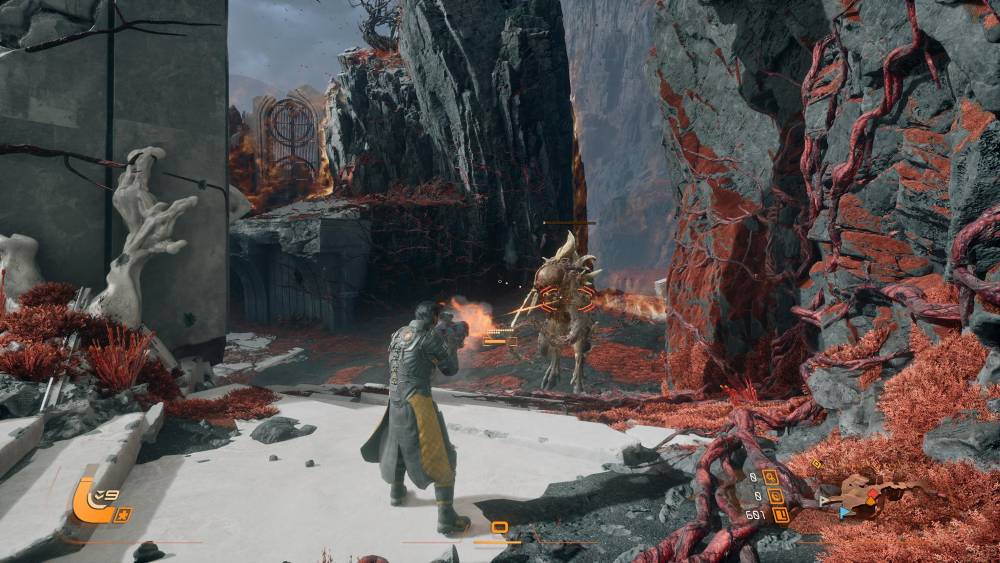
While comparisons to Returnal are inevitable, SAROS establishes its own identity with distinctive mechanics and a fully realized world. Carcosa, once a majestic city, now lies in ruins, with its baroque architecture reduced to a wasteland scarred by endless conflict. The biomes are expansive and designed for fluid traversal, encouraging players to jump, dash, and employ tools to navigate combat encounters.
True to Housemarque’s design philosophy, environments emphasize verticality and agility, keeping players in constant motion as they evade enemies, uncover secrets, and survive environmental hazards. Combat showcases the studio’s signature “bullet ballet,” a frenetic dance of running, dashing, and weaving through projectiles, just as exhilarating as before.
Players can fire their primary weapon, absorb blue projectiles with a shield to power devastating attacks, and experiment with a diverse arsenal ranging from hand cannons to exotic firearms, each with unique mechanics and alt‑fire variants.
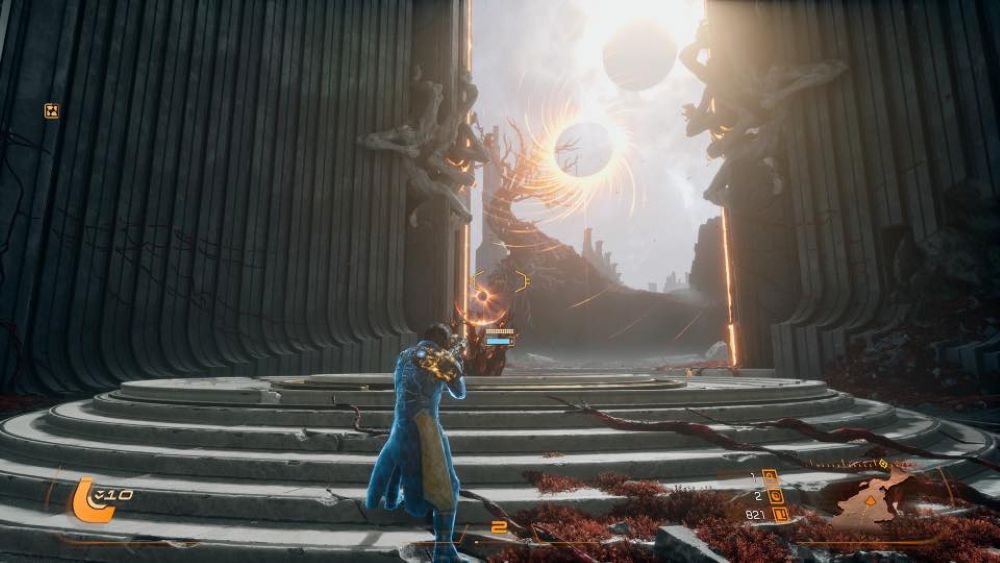
Projectile interactions add layers of strategy: blue shots can be absorbed, yellow attacks inflict corruption that reduces armor integrity, and red projectiles, while initially unavoidable, can later be parried. These color‑coded threats create a choreographed rhythm, rewarding mastery with a satisfying flow state.
Despite the complexity, mechanics quickly become intuitive, and each weapon feels distinct, offering weight, physics, and variants that encourage experimentation and will have players landing on a favorite firearm within a few runs. There’s a weapon for every playstyle, whether close range or long-range, and the many random effects that the weapons can take on add to provide more layers of min-maxing each run.
Housemarque has made it so that SAROS provides players with a solution to every problem in the game, and it is up to players’ creativity and skill to determine how they utilize the tools provided. You don’t have to parry or absorb bullets, and you can simply run and shoot, but engaging with all the systems elevates the experience that is undeniably incredible.
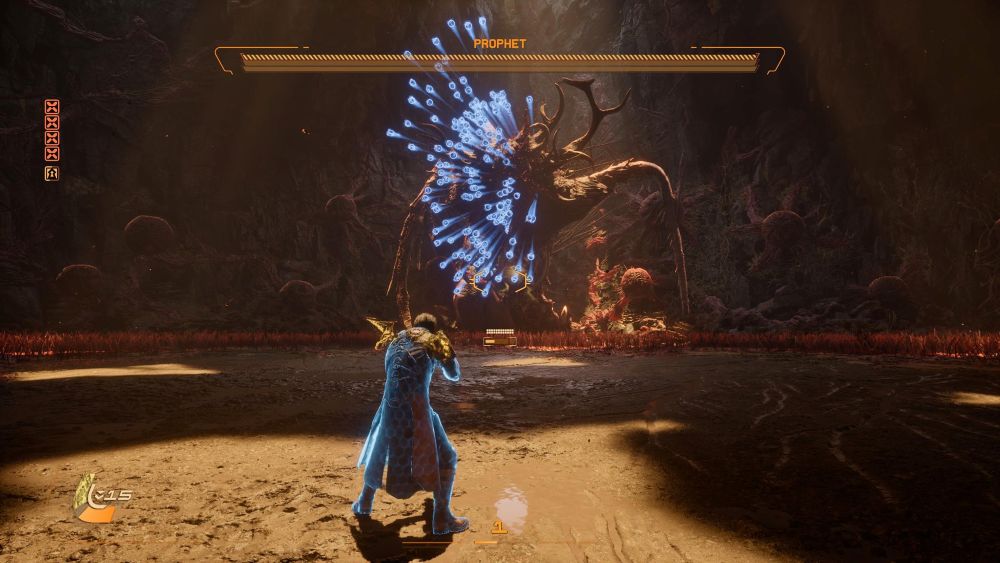
Progress through biomes culminates in battles against Overlords, encounters that unfold across multiple phases, each introducing new attack patterns. While creative in design, some boss and enemy behaviors are quite predictable, with difficulty often stemming more from increased damage output than from sophisticated AI or more complex, evolving patterns. Most bosses simply repeat attacks through all damage phases rather than presenting something totally new.
Even so, the spectacle of multi‑phase battles and the sheer scale of encounters remain highlights of the experience despite feeling like a step down from the majesty of Returnal’s bosses.
The Sun Is Forever
My playthrough of SAROS ran between 25–30 hours, though the total runtime will vary depending on how players utilize modifiers and armor augments, as well as their overall familiarity with roguelite systems. While SAROS is more accessible than Returnal, thanks to its progression mechanics and customization options, this does not diminish its impact.
What kept me returning was not just the gameplay loop, but the rich storytelling and layered lore. The mystery of Carcosa unfolds through text logs, audio files, and environmental storytelling, offering tantalizing fragments that raise as many questions as they answer. This fragmented narrative style compels players to dig deeper, piecing together meaning from contradictions and unreliable accounts. It’s safe to say the unfolding narrative in SAROS is easier to understand than the complex storyline of Returnal.
A welcome addition is the presence of surviving crew members from Echelon IV, who offer a brief respite from isolation. Unlike Returnal’s solitary experience, Arjun interacts with both his crewmates and the ship’s AI, grounding the narrative in human connection. Yet the story remains a puzzle to be put together, as Arjun’s perception of time and memory diverges from his companions’, positioning him as an unreliable narrator whose flashbacks and hallucinations are to be viewed with suspicion.
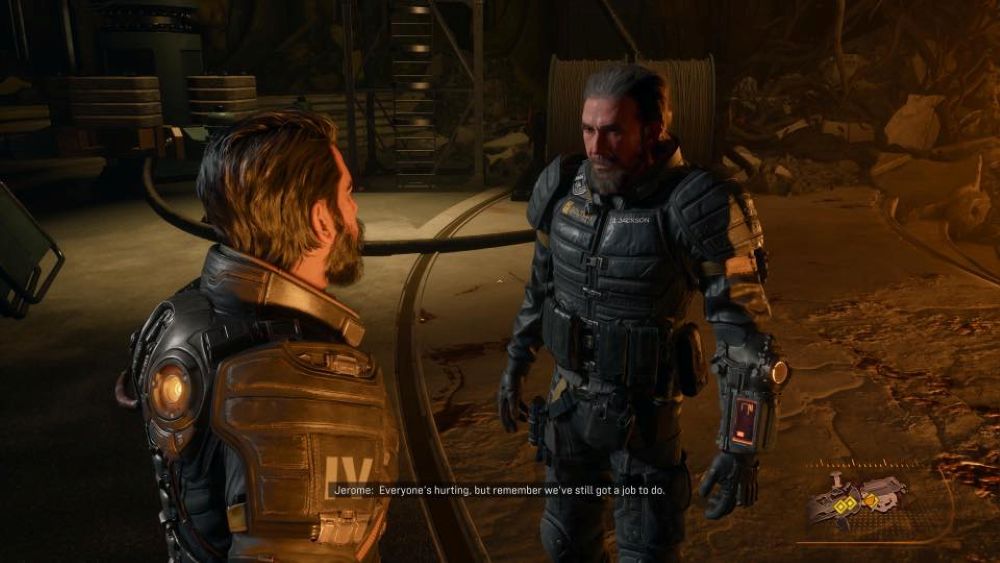
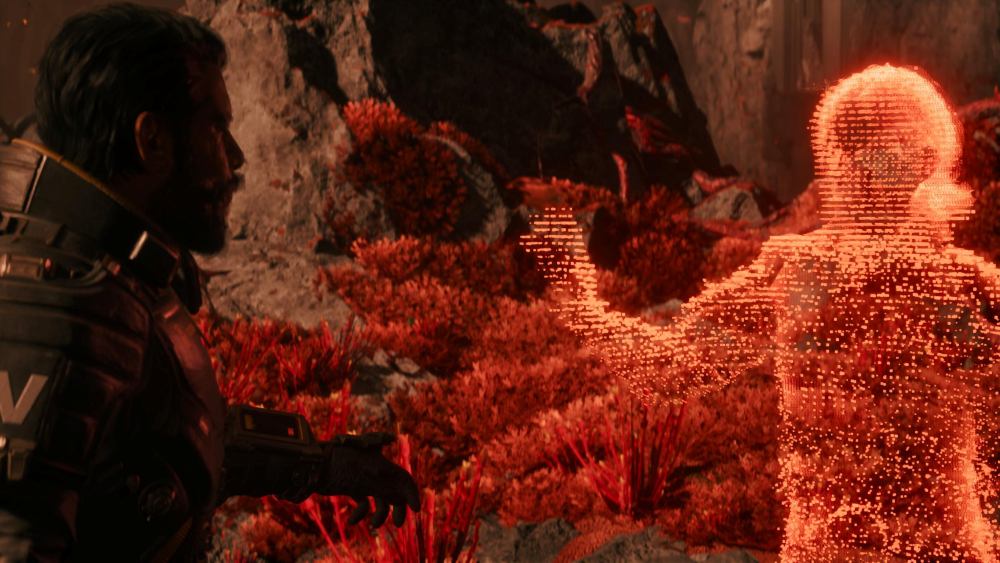
This descent into psychological conflict is reinforced by cutscenes and encounters within the Banyan Tree, echoing the surreal House sequences of Returnal. Data logs even shift in tone during the eclipse, transforming from redacted fragments into ramblings that mirror Arjun’s unraveling mind. Audio logs add further complexity, with contradictory testimonies from current and past surveyors, leaving players to interpret what truly happened on Carcosa.
The performances elevate the narrative. Rahul Kohli portrays Arjun with a stoic yet damaged presence, balancing determination with desperation. Shunori Ramanathan voices Nitya with nuance, her audio logs serving as both emotional anchor and haunting reminder of Arjun’s obsession. The supporting cast delivers a spectrum of emotions such as rage, despair, and zeal, which heightens the cosmic-horror atmosphere.
SAROS is another Housemarque triumph in audio design and DualSense controller use, combining to provide an experience unlike any other. Bullets whiz by players in the audio space, making it almost a requirement to play the game with a good set of headphones (or speakers). The use of haptics and adaptive triggers, similar to Returnal, also engages players in a mechanically satisfying way that really brings out the best in the game.
Ultimately, SAROS succeeds as a sci‑fi cosmic horror experience, blending the unsettling tone of Annihilation and Event Horizon with Housemarque’s bullet ballet combat. Its storytelling, mechanics, and thematic cohesion create an immersive package that compels players to return, chasing secrets that may never be fully revealed. With references to solar eclipse cycles and nods to The King in Yellow, SAROS weaves myth, madness, and gameplay into a singular vision that lingers long after each run.
Verdict: Buy It!

What we liked:
- Preserves its bullet ballet system as it delivers satisfying frenetic action.
- Accessible and approachable mechanics, allowing players to experience SAROS at their own pace.
- Unique and harrowing tale told through its unreliable plot reinforced by its rich lore and immersive storytelling.
What we didn't like:
- Enemy AI is predictable, the difficulty lies on heightened damage.
- Enemy variants feel uniform.
- Level design and secret rooms feel a little uniform.
SAROS stands as a strong successor to Returnal, carving out its own identity with a more approachable experience while retaining Housemarque’s signature bullet ballet combat. It remains challenging, though its accessibility may feel less punishing than that of its predecessor. For fans seeking the same relentless difficulty, SAROS might seem lighter, but its appeal extends far beyond mechanics.
Beneath the frenetic action lies a story of obsession, regret, and redemption, told through a fragmented narrative that grips players with its unsettling mystery right up to the climactic finale. This layered storytelling, paired with its cosmic-horror atmosphere, ensures that SAROS resonates on both emotional and thematic levels.
Housemarque continues to prove itself as one of PlayStation Studios’ most daring creative teams, delivering unique and exceptional experiences. SAROS is quite possibly a Game of the Year contender and undoubtedly one of the year’s standout titles, a game that challenges the mind, stirs the heart, and leaves players haunted long after the credits roll. It is pure action bliss, and Housemarque at their peak.
*SAROS was reviewed on a PS5 with a review code provided by the publisher.
