

Resident Evil Requiem is One of The Most Accessible PC Ports Yet From Capcom
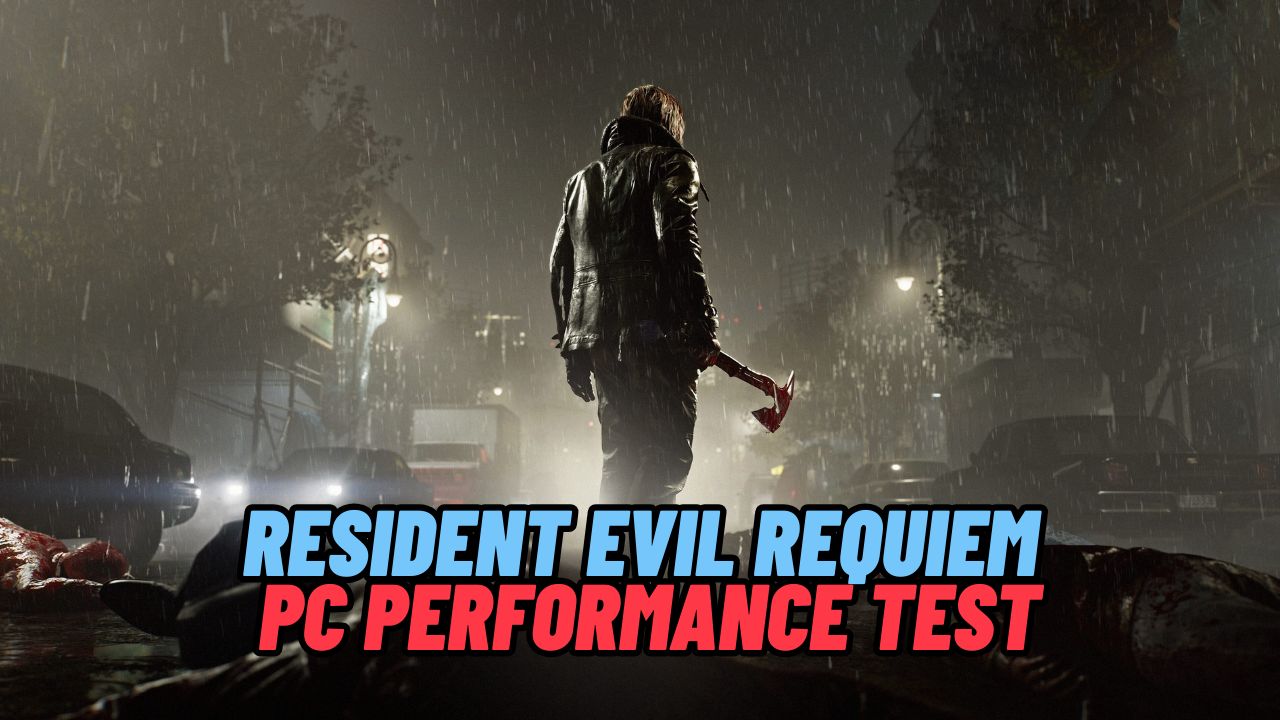
The Resident Evil series is a cornerstone of survival horror, setting the standard for atmosphere, tension, and gameplay innovation since its debut on the PlayStation in 1996. When it was first released, it introduced players to mechanics such as limited resources and a dreadful atmosphere, which have since become staples of the genre. Over the years, its evolution from tank-like camera controls to over-the-shoulder and even first-person has continuously redefined its identity, with themes and lore spanning decades, keeping fans wanting more.
Despite its stellar history on consoles, its expansion to PC has been a rollercoaster. Long before the polished releases we see today, previous ports often lacked polish and function compared to their console counterparts, with Resident Evil 4 being quite infamous when compared to the GameCube version.
The turning point came in 2017, when the RE Engine debuted with Resident Evil 7: Biohazard. Arguably one of the most well-optimized engines today, the RE Engine is well known for allowing titles to shine across a variety of PC specs, even more modest ones. Capcom has consistently delivered high-performance ports that prioritize scalability, and this trend continues with the recently released Resident Evil Requiem, which is a testament to how far the company has come in elevating both quality and performance in its PC ports.
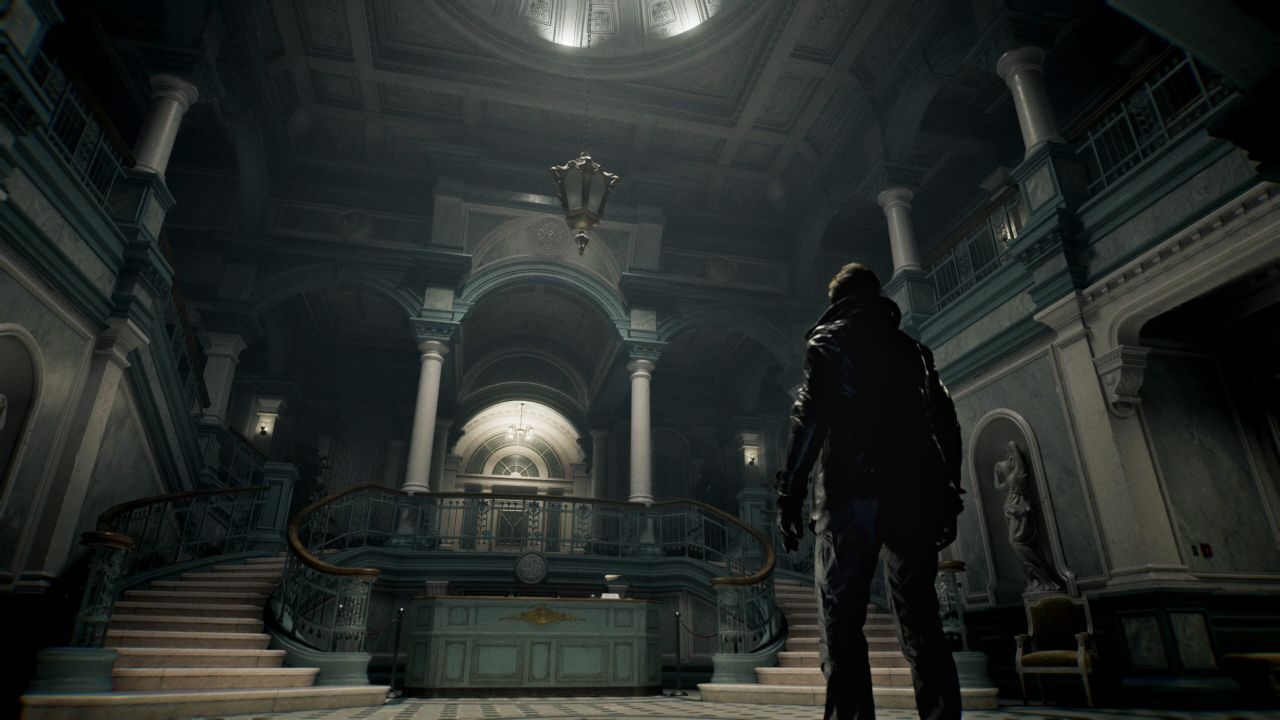
Resident Evil Requiem System Requirements
This is the first of a four-part series that dives deep into Resident Evil Requiem as we put it through its paces across various GPUs to test how well-optimized the game really is on PC.
Capcom has designed Resident Evil Requiem to be accessible, even for those who haven’t upgraded their rigs in a few years. In fact, the system requirements explicitly state that the GTX 1660, a 2019 graphics card, can still play the game! That is, without mincing terms, exceptional, considering some titles that require 20 to 30-series cards at a minimum.
However, there is a notable floor when it comes to memory, requiring at least 16GB to carry the load.
| Component | Minimum Requirements | Recommended Requirements |
| OS | Windows 10/11 (64-bit) | Windows 10/11 (64-bit) |
| CPU | Intel Core i5-8500 / AMD Ryzen 5 3500 | Intel Core i7-8700 / AMD Ryzen 5 5500 |
| RAM | 16 GB | 16 GB |
| GPU | NVIDIA GTX 1660 (6GB) / RX 5500 XT 8GB | NVIDIA RTX 2060 Super 8GB / RX 6600 8GB |
| DirectX | Version 12 | Version 12 |
| Performance | 1080p gameplay (using upscaling, native resolution of 640p)/30fps. SSD Required | 1080p gameplay (using upscaling, native resolution of 720p)/60fps. SSD Required. |
This is especially an important consideration in our current technological climate. The demands of many modern AAA titles are absurd, often requiring upgrades costing hundreds of dollars just to play at a respectable level. In an era where GPU and RAM prices remain volatile, Resident Evil Requiem’s ability to run on a graphics card nearly seven years old is a massive win for the general gaming public.
Resident Evil Requiem Test Bench Specs and Benchmarks
| CPU | AMD Ryzen 7 9800X3D |
| COOLER | ASUS ROG RYUJIN II 360mm V2 – NT-H2 Thermal Paste |
| MOTHERBOARD | Gigabyte X870E Aorus Master |
| MEMORY | GSkill Trident Z Neo 32GB(2x16GB) DDR5-6000 CL28 |
| GPUs | Palit GeForce RTX 3050 | DRIVER 595.97 |
| STORAGE | Kingston Renegade 2TB NVME SSD |
| POWER SUPPLY | FSP VITA GM1000W Gold ATX 3.1 |
| OPERATING SYSTEM | Windows 11 Pro Build 25H2 |
| CASE | Open Benchtable V2 |
Speaking of the general gaming public, for this benchmark, we’ll be using the Palit GeForce RTX 3050 8GB GPU, a reasonably old yet very popular GPU that placed 16th in Steam’s March Hardware Survey with a 2.97% market share. Considering that GPU prices started to balloon with the 40-series, with launch pricing over $1,000 for the 4080, many gamers have held on to their still-capable 30-series cards or older to this day.
The RTX 3050 is a tier above the minimum requirement of a GTX 1660 but falls slightly behind the recommended RTX 2060 in pure rasterization performance. Despite that, the RTX 3050 offers improved power efficiency and better AI-related technologies because it’s one GPU generation newer, which is a trend we’ve seen with GPU launches.
With Resident Evil Requiem requiring a fairly standard 16GB, and with CPUs being one of the parts that are easily upgradable, we decided to focus this benchmark test purely on the GPU capabilities to demonstrate just how superb Capcom’s RE Engine optimization is. The results are surprisingly good, giving credence to Capcom’s ongoing PC efforts.

Settings Preset Benchmarks
Testing the Presets for Resident Evil Requiem will show us how well the game’s optimization scales performance with the graphic fidelity you see in the game. Resident Evil is available on all game platforms, and, like most games, PC is usually challenging to optimize due to the almost infinite number of hardware combinations across CPUs, Motherboards, RAM, and GPUs. Add the many other variables on a PC, and there’s just so much that can happen in between.
By testing these presets, we can get a good idea of performance scaling on the RTX 3050 GPU, a GPU we could consider mid-tier, as it sits nicely between the minimum and recommended system requirements. Moreover, this shows the stability and optimization indicated by the 1% FPS lows; a smaller delta between settings translates to a more stable gameplay experience and better overall optimization.
1080p Gameplay
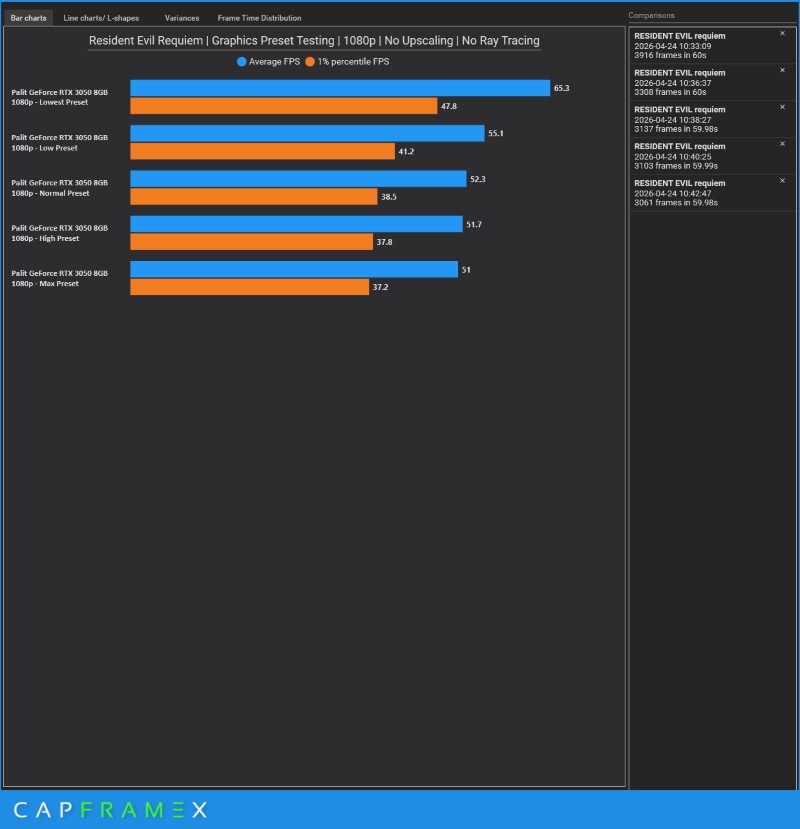
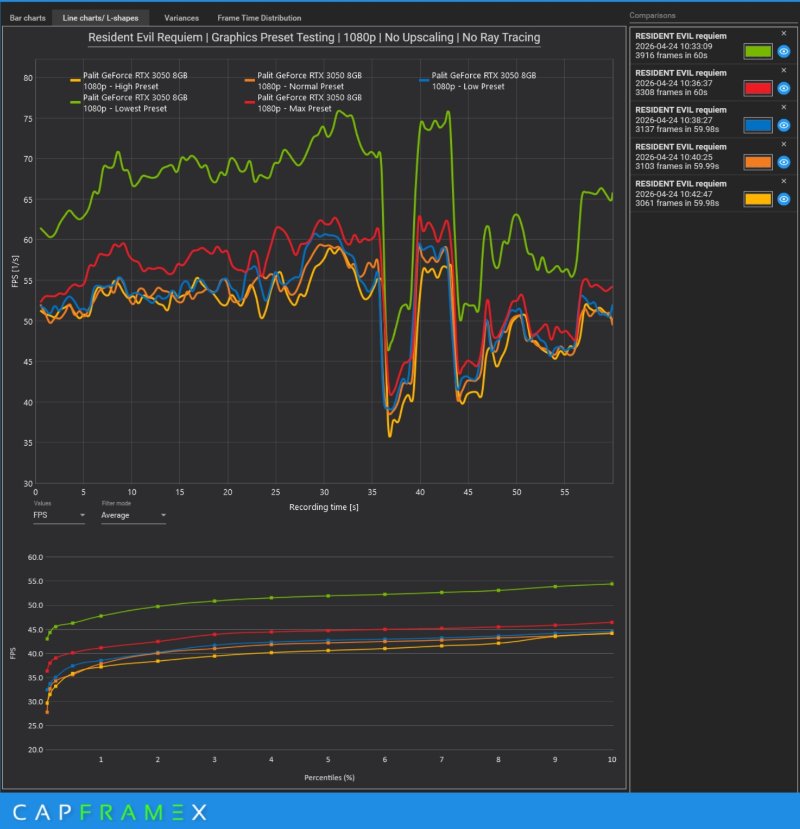
When it comes to pure rasterization, the RTX 3050 8GB performs admirably while playing Resident Evil Requiem, hovering around 50 FPS at 1080p on any preset without ray tracing or upscaling, and hitting upwards of 60 FPS on the lowest preset. These are exceptional results, considering negligible performance drops when switching between presets. The minimal delta between presets, roughly 14 FPS, indicates consistent frame pacing and efficient scaling, ensuring smooth gameplay even at higher-fidelity settings.
It bears reiterating that we are talking about Resident Evil Requiem, the latest entry in the long-running series and a AAA release in 2026. For something like this to run at over 50 FPS on the max preset with no ray tracing and no upscaling is amazing, and it’s not only a showcase of the 3050’s capabilities but also of the RE Engine, allowing titles to scale effectively across various PC setups.
1440p Gameplay
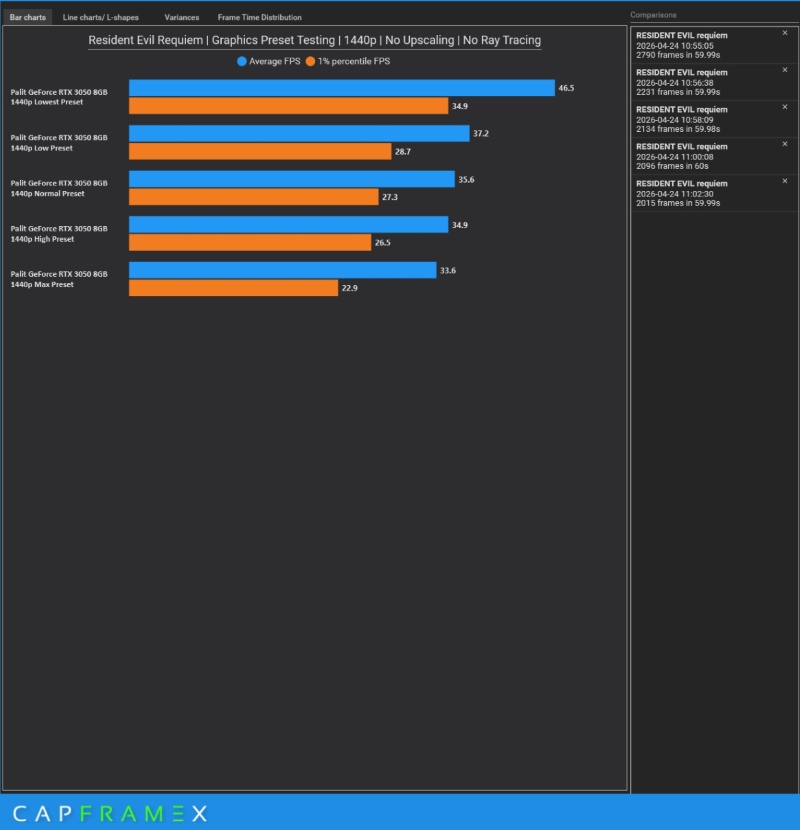
Testing at 2560x1440p resolution shows a more consistent story, proving once again that Resident Evil Requiem is well optimized. At the lowest preset, we can go as high as 46 FPS, and as low as 33 FPS at the max preset. This demonstrates a common delta with 1080p gameplay, losing around 13-14 FPS when switching, which is quite negligible.
That said, the RTX 3050 isn’t meant for 1440p gaming in the first place, yet it can deliver console-like 30fps gameplay even at the highest graphics preset. The Stable 1% lows at 1440p show that the game isn’t VRAM-hungry, which is ideal, especially given the current RAM and SSD price hikes.
1080p Gameplay with DLSS Upscaling
Unsurprisingly, the use of upscaling technology such as DLSS gives us a huge performance boost with very minimal impact on graphics fidelity. Given this fact, it almost feels like a no-brainer to recommend turning this on. With DLSS set to Quality at the High preset, we’re talking about a 60 FPS experience, 63.5 FPS to be exact, with Balanced just marginally above at 67.9 FPS. That’s a phenomenal result for a 4-year-old GPU, and given that games like Resident Evil Requiem prioritize ambiance and atmosphere, hitting 60 FPS while maintaining high settings is an easy recommendation.
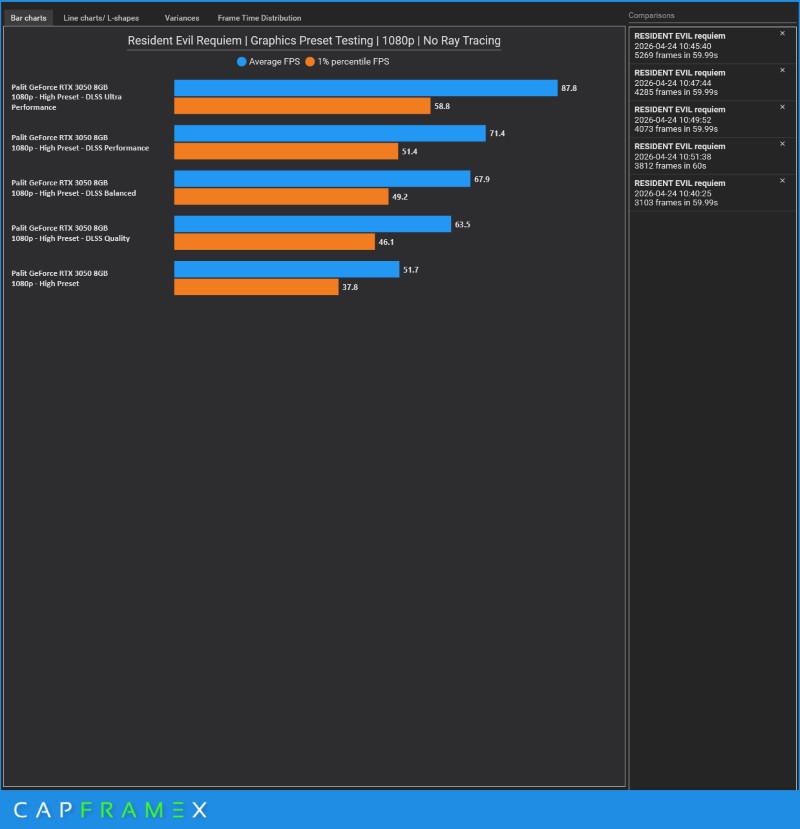
Capcom’s Resident Evil Requiem is a remarkably accessible PC port, thanks to the RE Engine’s scalability and optimization. The game runs smoothly even on mid‑tier hardware like the RTX 3050 8GB, maintaining over 50 FPS at 1080p on high settings and reaching a minimum of 60 FPS with DLSS enabled. This level of performance stability across presets, with only a 14 FPS delta between the lowest and max, demonstrates how efficiently the engine balances visual fidelity and frame pacing.
More importantly, Resident Evil Requiem exemplifies how a AAA title can deliver a premium experience without demanding cutting‑edge hardware, even accommodating GPUs as old as the GTX 1660. Its consistent frame times, minimal VRAM dependency, and strong upscaling support make it playable on a wide range of setups without the need to upgrade. In an era where many PC ports struggle with optimization, Requiem is a rare success, resulting in a technically polished, scalable release that ensures players everywhere can enjoy the haunting atmosphere and refined gameplay Capcom is known for.
Resident Evil Requiem is now available on PS5, Xbox Series, Switch 2, and PC via Steam.
